INSIGHTS
Capital flows underpinning India's energy transformation: IEEFA
Tim Buckley, Director, Energy Finance Studies, and Saurabh Trivedi, Research Analyst, share their insights on how global capital is primed and ready to boost India's growth as a renewable energy powerhouse


India is the veritable sweet spot that has stoked the interest of global capital managers all over the world owing to its green energy transformation that presents an electricity infrastructure opportunity worth US$500bn. Backed by clarity, transparency and relative stability of government energy and climate policy under Prime Minister Narendra Modi, the offer of 25-year power purchase agreements at scale, secured by a Central Government sovereign guarantee, it is mobilising a huge global capital pool.
While 2020 saw economic setbacks in India, the year also saw significant capacity building in the renewable and grid infrastructure sectors, with a deepening of the engineering, procurement and construction (EPC), management and financing capacity across India which will likely pay dividends in 2021 and beyond.
In the grid transmission sector, consumers are increasingly benefiting from grid expansion and modernisation at lower costs due to private sector challengers to Power Grid Corp, led by Adani Transmission, Sterlite Power and IndiGrid InvIT.
In 2020, India stood third, globally, in terms of total renewable installations. The country also improved its ranking to fourth from seventh (2019) in the Renewable Energy Country Attractiveness Index. It is also one of the few countries on track to meet its Paris Agreement commitments; the carbon emissions per dollar of GDP has already fallen 14per cent below 2005 levels, energy capacity from renewables (including hydro) now makes up 37per cent, or 143 gigawatts (GW), of India's total energy capacity (the aim is for 40per cent of installed capacity to come from renewables by 2030), and it ended the financial year (FY) 2020-21 with a total installed renewable energy capacity of ~95GW, at a compound annual growth rate (CAGR) of 19per cent.
According to the IEA (International Energy Agency), India will need US$1.4 trillion in additional funding for low-emissions technologies in order to be on a sustainable path over the next 20 years. These are mammoth goals to strive for. India still requires significant effort and huge amounts of capital to achieve its 2022 target, having hit combined headwinds with the economic slowdown in 2019 followed by the COVID-19 disruptions of 2020, which have seen electricity flatline over the last two years.
One of the major barriers to achieving these targets is the amount of patient capital required.
The renewable energy sector in India has received more than US$42bn in investment since 2014 but requires a further US$500bn over the next decade in order to achieve its 2030 renewable target. This includes the capital cost of adding more than 300GW of new renewables infrastructure, firming low-cost but intermittent renewable power generation, and expanding and modernising grid transmission and distribution.
Thus, the need to keep attracting capital into new projects as well as accelerate existing investment into renewable energy projects, is a sine qua non for India's renewable infrastructure sector. Over the past two years, the sector has experienced significant mergers and acquisitions activities, 13 green-bond issuances, and spinning-off of operating renewable assets via infrastructure investment trust (InvIT). This has helped unlock and recycle the existing capital, freeing up project developers' capital to take on ever-larger tender opportunities.
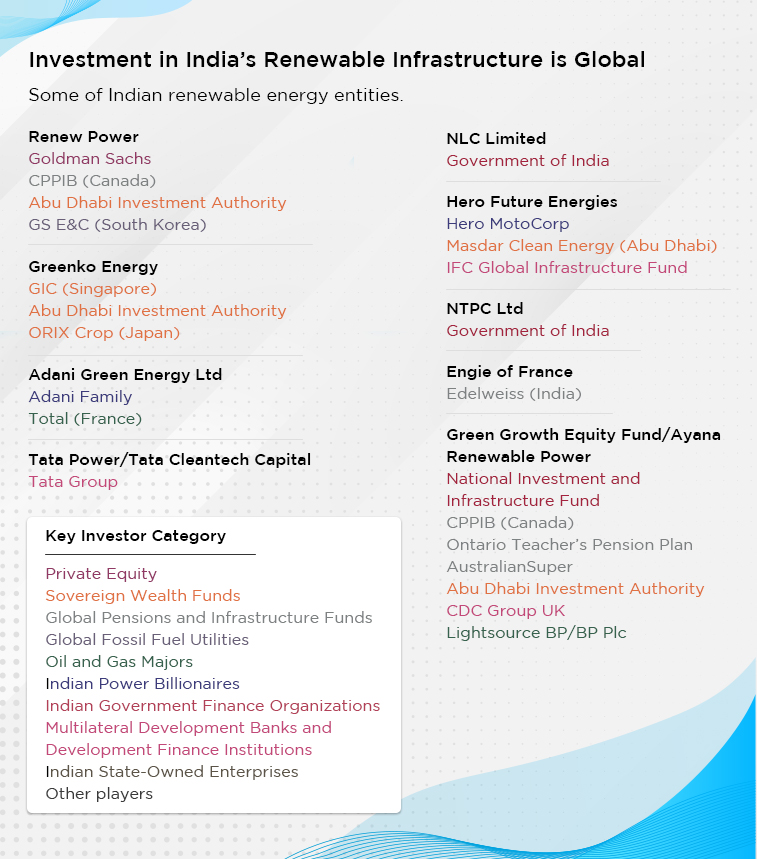
The key institutions that are playing a pivotal role in refinancing existing operating renewable energy assets are Private Equity, Sovereign Wealth Funds, Global Pensions and Infrastructure Funds, Global Fossil Fuel Utilities, and Oil & Gas majors. These institutions are set to play a critical role in delivering on India's renewable energy growth. Their transactions and investment commitments have helped build out financial and operational capacity in the renewable and grid infrastructure sectors.
As global momentum towards delivering on the Paris Agreement builds, the rapidly growing pool of global capital will prove to be the catalyst that will enable India to deliver more than its fair share of the solutions.
Excerpt from IEEFA (Institute for Energy Economics and Financial Analysis) Report on Capital Flows Underpinning India's Energy Transformation - Published in Feb 2021